
Merz declares Germany growing again as economy shakes off three-year recession
BERLIN — German Chancellor Friedrich Merz proclaimed on Wednesday that the country's prolonged economic slump has come to an end, announcing that after three consecutive years of r
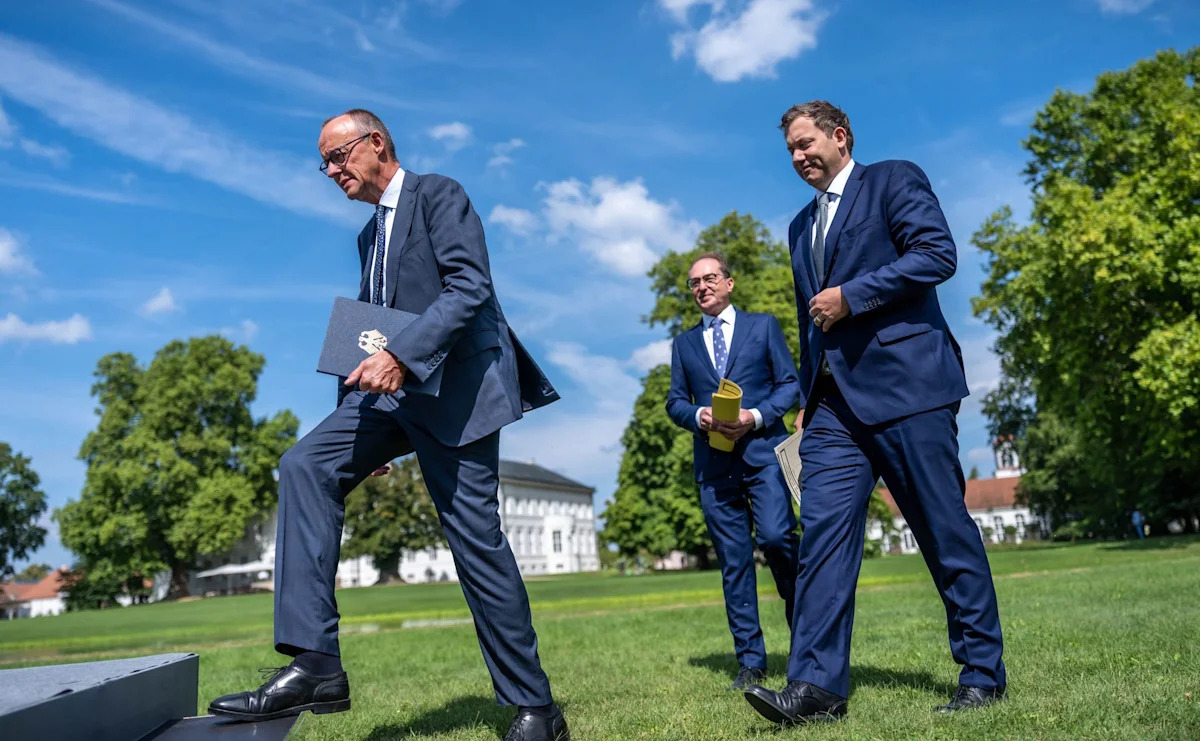
BERLIN — German Chancellor Friedrich Merz proclaimed on Wednesday that the country's prolonged economic slump has come to an end, announcing that after three consecutive years of recession, Germany has returned to growth.
The conservative leader delivered his assessment at the close of a two-day Cabinet retreat held at Neuhardenberg Castle in the state of Brandenburg, just outside Berlin, where ministers met behind closed doors to take stock of the country and set priorities for the rest of the year. He appeared before reporters alongside Vice Chancellor and Finance Minister Lars Klingbeil and Interior Minister Alexander Dobrindt.
"We have three years of recession behind us and now we are growing again," Merz said, adding: "Full concentration on growth."
Looking ahead to the remainder of the year, the chancellor said his government was entering the final months of 2026 with energy and great confidence. By December, he predicted, the administration would be able to point to a record that speaks for itself: out of recession, out of economic weakness, and out of the discontent and distrust of recent years, and into a new confidence.
The declaration caps one of the most difficult stretches in modern German economic history. Output contracted for three straight years, leaving Europe's largest economy lagging behind its peers, while the war involving Iran dealt a fresh blow earlier this year by driving oil and gas prices sharply higher. Even with the incipient recovery, analysts expect only minimal growth for 2026 as a whole. The prolonged malaise also fed much of the public frustration that Merz said his government is now working to overcome.
Still, the indicators have been pointing upward in recent weeks. New figures from the Federal Statistical Office show gross domestic product expanded by 0.3% in the April-to-June period compared with the previous quarter — an advance secured despite the setbacks caused by the conflict. The result was 0.1 percentage point stronger than initially estimated.
Business sentiment has brightened as well. The ifo business climate index rose again in August, extending a run of improving survey data and reinforcing the impression that the economy has passed its low point. The gauge, based on regular surveys of German firms, is widely regarded as one of the most reliable early signals for the direction of Europe's biggest economy.
Merz said innovation and competitiveness were the central focus of the retreat at Neuhardenberg, positioning them as the foundation for turning the tentative upswing into lasting strength rather than a fleeting rebound.
He singled out artificial intelligence as a prime example of where progress can be made, citing potential uses across industry, the skilled trades, small and medium-sized businesses, defense and medicine. Germany, he argued, holds "unexpectedly great opportunities" in the field.
For a chancellor whose tenure began amid stagnation, industrial anxiety and strained public finances, the buoyant tone marked a deliberate shift in register — and an attempt to convert early green shoots into political momentum.
Officials remain aware that risks persist, from elevated energy prices to ongoing geopolitical turmoil. But the message from Brandenburg was clear: the government believes the corner has been turned and intends to keep growth at the top of its agenda through the end of the year.
--- END ---
What's Your Reaction?
 Like
0
Like
0
 Dislike
0
Dislike
0
 Love
0
Love
0
 Funny
0
Funny
0
 Wow
0
Wow
0
 Sad
0
Sad
0
 Angry
0
Angry
0

Reporter Kriminal. Meliput Polri, kejaksaan, dan pengadilan pidana.
Comments (0)