

Armenia Set to Pursue EU Membership Bid in Landmark Break From Moscow's Orbit
Armenian Prime Minister Nikol Pashinyan announced Monday that his government will start laying the groundwork for a formal application to join the European Union, marking one of th
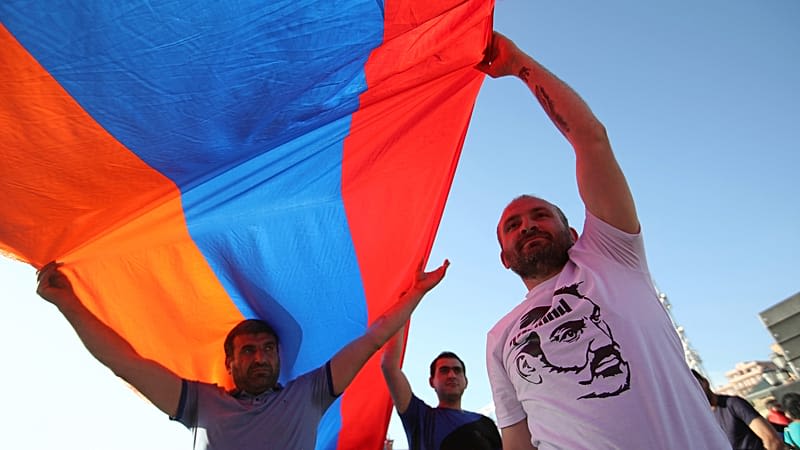
Armenian Prime Minister Nikol Pashinyan announced Monday that his government will start laying the groundwork for a formal application to join the European Union, marking one of the most dramatic realignments in the South Caucasus since the Soviet collapse.
Addressing parliament, Pashinyan laid out a carefully sequenced path: Yerevan will first submit its membership bid "in the near future," await Brussels' response, negotiate an accession roadmap with the bloc, and only then put the question of joining to voters in a nationwide referendum.
The announcement escalates a confrontation that has been building for months. Fellow members of the Russia-led Collective Security Treaty Organisation (CSTO), of which Armenia remains a part, had pressed Yerevan to choose between staying in the alliance or pursuing EU integration through a public vote. The Kremlin has reacted angrily to Armenia's westward drift, with President Vladimir Putin previously warning of a "Ukrainian scenario" and Moscow imposing waves of economic pressure on the country.
Pashinyan appeared to welcome an exit, telling legislators he would be pleased if the CSTO expelled Armenia outright, since that "would at least free us from the dilemma of whether or not to leave." For now, however, he said Armenia will stay in the pact until a break becomes unavoidable.
The prime minister argued that the assumption underpinning two centuries of Armenian-Russian ties — Moscow as guarantor of the nation's security — had been shattered by events. He pointed to the years 2021 through 2023, when Russia proved unable or unwilling to protect Armenia during its clashes with Azerbaijan over Karabakh, saying his country had failed to learn the lessons of its own history.
The Karabakh conflict formally ended with a peace process signed in August 2025, and Armenia and Azerbaijan have since pursued economic cooperation with backing from the EU and the United States. Still, Armenia's economy remains tethered to Russia through energy supplies and infrastructure. In another challenge to Moscow, Pashinyan called on the Kremlin to surrender its concession over Armenia's railways, which runs until 2038, so the network can link up with international corridors — with Kazakhstan or the United Arab Emirates floated as potential investors.
Moscow lost little time in pushing back. Kremlin spokesman Dmitry Peskov warned that aligning with EU standards could produce "deep trade contradictions" that would hurt Armenia first, while noting that if Yerevan no longer sees value in CSTO membership, it is free to walk away — a sign that the split between the former allies is likely to be contentious.
What's Your Reaction?
 Like
0
Like
0
 Dislike
0
Dislike
0
 Love
0
Love
0
 Funny
0
Funny
0
 Wow
0
Wow
0
 Sad
0
Sad
0
 Angry
0
Angry
0

Editor Hukum. Alumni FH UI. Meliput pengadilan, MA, dan judicial review.

Comments (0)